
The -Flation Nation
Photo by Joachim Schnürle on Unsplash
The '-Flation Nation? Say what now? Mind you, I'm not bleeping out a curse word. Although, my guess is that the various -flation words I'm about to talk about may make some of us want to curse, or at least make our wallets want to curse.
So what am I talking about? It seems like there are a lot of words being thrown about that end in "flation". And it can be hard to keep them all straight sometimes.
The ones I'm talking about include inflation and deflation, which are the most common, but you also may have heard of stagflation, and the less well-known disinflation.
Let's talk about the -flation words that are taking over our nation.
Inflation
The most common, and probably most relevant to our daily lives, is of course inflation. For the better part of 6 years, we have been feeling the effects of inflation, particularly at the gas station and the grocery store.
A simple definition is that inflation means prices are increasing, usually due to things like rising wages, increased demand for goods and services, increased money levels, and/or supply shortages.
Inflation can lead to reduced purchasing power (i.e., consumers not being able to purchase as much due to prices being higher) and interest rate increases.
Deflation
Deflation is basically the opposite of inflation. It's when prices in the economy are generally decreasing.
This might sound good at first, but deflation can be quite damaging.
The problem is that, if prices are in a downward trend, people tend to wait to make purchases. After all, why buy something now if it's likely to be even cheaper next week? It's completely rational to wait.
But that holding off on purchases can dramatically affect the companies selling the products, which pressures profit margins and can lead to layoffs. That, in turn, reinforces a downward spiral of people spending even less.
Disinflation
Many of you may be surprised to hear that deflation and disinflation are different things. But they very much are.
Disinflation is when there's inflation, but it's slowing down.
It's when prices are still rising but not as fast as they have been, or in other words, a decrease in the rate that prices are increasing.
This is largely what we've been experiencing the last several years (with the exception of the past handful of months), and it's generally a good thing. And right now, it's the goal of the Federal Reserve, as they want to get inflation down to around 2%.
Stagflation
The most worrisome of the -flations we're discussing today is stagflation.
It is a rather unique combination of three things at once: high inflation, stagnant or negative growth, and rising unemployment.
Basically, everything gets more expensive, while jobs and growth are declining. This was seen in the 1970s when incredibly high inflation was coupled with an economic recession.
Stagflation can be a little scary in that it's hard to break, due to its unique make-up. The strings that central banks pull to help with inflation tend to weaken economic growth. And the levers they pull to stimulate growth tend to increase inflation.
This is too much... I need a chart
Your needs are hereby accommodated. Check out this chart to help compare the various -flations.
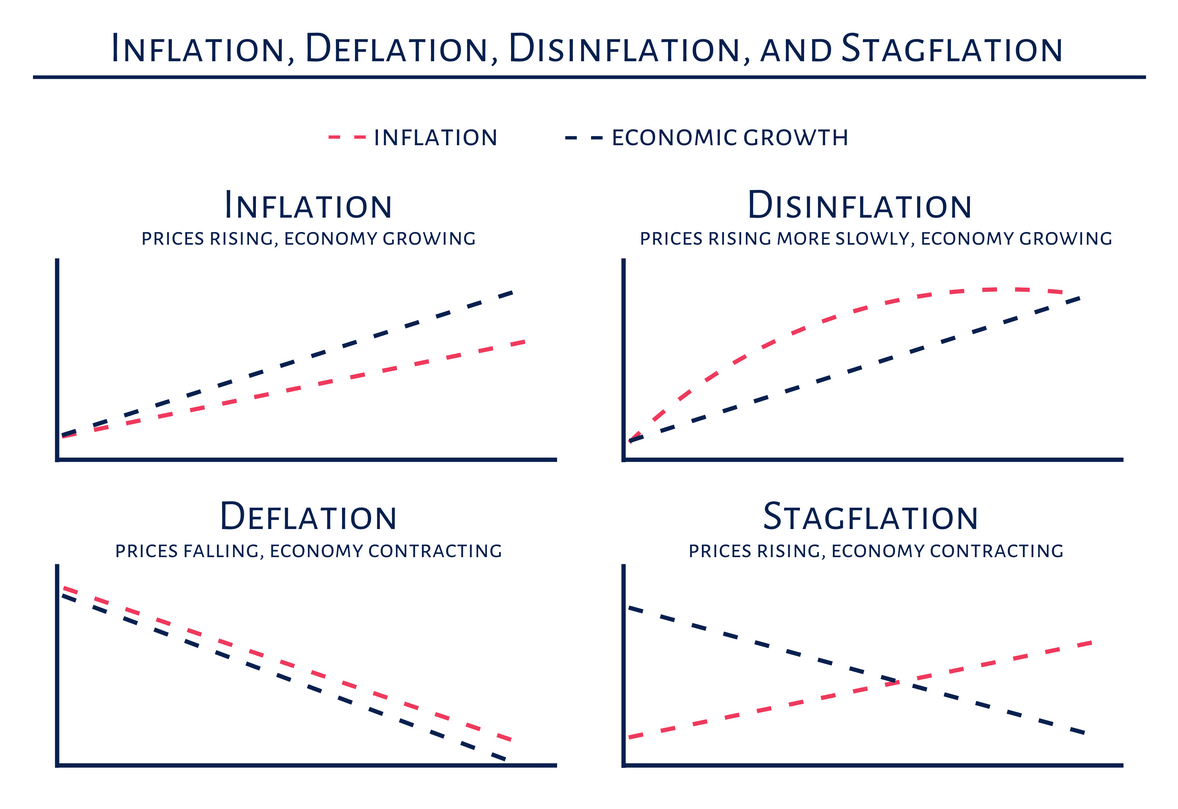
The -flations explanations
So what do all these -flations mean for us average Joe's and Jane's in our everyday life?
Well, despite all the worry, and our wallets cursing us, I think it's important to remember that we are definitely not in the worst-case scenarios of stagflation or deflation.
Yes, inflation has picked up, unemployment is rising a little, but both of these remain below their 50-year averages, which is a positive note. And during that same 50-year stretch, we have experienced some of the strongest economic periods in history. Furthermore, GDP remains fairly positive despite the current inflation rate.
But all in all, considering the growth we've experienced recently, a little slowdown shouldn't surprise any of us too much.
The bottom line
All this to say, I don't think any of us needs to panic. Especially you in the second row. Yes, you in the green shirt.
And we shouldn't be comparing ourselves too closely to the 1970s stagflation era, as we don't seem to be headed that way.
Could prices be cheaper? Surely.
Could unemployment be better? Of course.
But could both of these things be worse? Oh yeah.
No one is claiming the current economy is perfect, but we should remain grateful that we are not presently facing the worst-case scenarios. And as always folks, stay the course.